
Affiliate disclosure. PetBuyLab may earn a commission when you buy through qualifying links. This does not affect the products we include, the tradeoffs we explain, or the price you pay.
The best dog ramp for a car or SUV is not simply the model with the highest weight limit. It must be long enough for your loading height, wide and stable enough for your dog, grippy in both directions, and practical enough that you will actually use it. For most families the Extra-Wide 74″ x 20″ Dog Car Ramp is the strongest all round starting point. For tall SUVs, trucks or dogs that need a gentler, adjustable slope, the PetSafe Happy Ride Compact Telescoping Ramp is the more adaptable choice.
This guide compares ten options available on Amazon by their published design, dimensions, portability, traction, stability features and likely use case. PetBuyLab did not physically test these ramps. Specifications and availability can change, so confirm the current listing and measure your vehicle before buying.
Our top picks at a glance
How we selected these products
We began with the decision factors that matter in real use: working length, incline at common vehicle heights, walking width, traction, resistance to sliding, weight capacity, product weight, storage shape and top edge security. We then reviewed manufacturer information, current retailer listings, independent editorial comparisons and recurring owner concerns. Products were assigned to the use case where their design makes the most sense rather than forced into a single universal ranking.
This is research based editorial selection, not hands on testing. We do not claim that a dog walked on a product, that a ramp was load tested by PetBuyLab, or that a veterinarian approved our list. Read our editorial and corrections policy for how we choose products, handle accuracy and disclose affiliate relationships.
How to choose the right ramp before reading the reviews
Start with loading height and usable length
Measure vertically from the ground to the surface where the upper edge of the ramp will rest, then check the working length rather than the folded length. A longer ramp spreads the same rise over more distance and usually produces a gentler approach. This matters most for senior dogs, dogs with arthritis, short legged breeds and dogs that lack confidence on inclines.
Treat traction and stability as separate questions
Traction keeps paws from sliding on the walking surface. Stability keeps the whole ramp from rocking, bowing or moving away from the vehicle. Rubber feet, a secure upper lip and a tether can matter as much as the tread. Press the unloaded ramp at the lower, middle and upper sections before letting your dog on.
Check width and edge guidance
Large dogs and dogs with an unsteady gait need more usable width than a small, coordinated dog. Side rails help a dog read the path but do not fix a narrow deck. Measure the walking surface, not the maximum exterior width.
Respect the weight rating but look beyond it
The published capacity is a filter, not a full safety score. A ramp can hold the weight and still feel springy or narrow. Choose meaningful capacity above your dog weight, follow the setup instructions, and retire any ramp that is cracked, distorted or missing non slip parts.
What length ramp for your vehicle
Match the ramp to your vehicle first. Measure from the ground to the boot floor or tailgate, aim for roughly three times that height, and keep the incline shallow. These ranges are planning examples, not a substitute for measuring your own vehicle.
| Vehicle or access point | Typical loading height | Ramp direction | What to avoid |
|---|---|---|---|
| Sedan side or rear door | 16 to 24 in | A 60 to 66 inch ramp, securely positioned | A wide ramp that cannot sit flat at the opening |
| Crossover or compact SUV | 24 to 28 in | Around 66 to 72 inches, then test the real angle | Choosing by vehicle class without measuring |
| Midsize or full-size SUV | 28 to 34 in | 72 inches or an adjustable telescoping ramp | Short bi fold ramps that create a sharp climb |
| Pickup tailgate or lifted SUV | 32 to 40 in or more | The longest compatible ramp, up to 87 inches | A ramp that leaves a gap or unstable lip |
How the 10 ramps compare
| Ramp | Length | Width | Rating | Typical price |
|---|---|---|---|---|
| Extra-Wide 74″ x 20″ Dog Car Ramp | 74″ | 20″ | 4.5 stars | ~$110 |
| PetSafe Happy Ride Compact Telescoping Ramp | 28 to 70″ | 16″ | 4.3 stars | ~$160 |
| 87″ Aluminum Extra-Long Ramp | 87″ | 17″ | 4.9 stars | ~$180 |
| Pet Gear Tri-Fold 71″ Ramp with SupertraX | 71″ | ~16″ | 4.2 stars | ~$130 |
| PetSafe Happy Ride Folding Ramp | 62″ | 16″ | 4.1 stars | ~$60 |
| Extra-Wide 74.8″ x 20″ Folding Ramp | 74.8″ | 20″ | 4.8 stars | ~$130 |
| PawStep Portable Folding Ramp | ~71″ | ~17″ | 4.4 stars | ~$80 |
| High-Grip 71″ x 20″ Non-Slip Ramp | 71″ | 20″ | New | ~$110 |
| Compact 63″ x 17″ Folding Ramp | 63″ | 17″ | 4.5 stars | ~$100 |
| Dog Stairs with Guardrail | Steps | n/a | 4.5 stars | ~$58 |
The 10 best dog ramps for cars and SUVs
1. Extra-Wide 74″ x 20″ Dog Car Ramp · Best overall
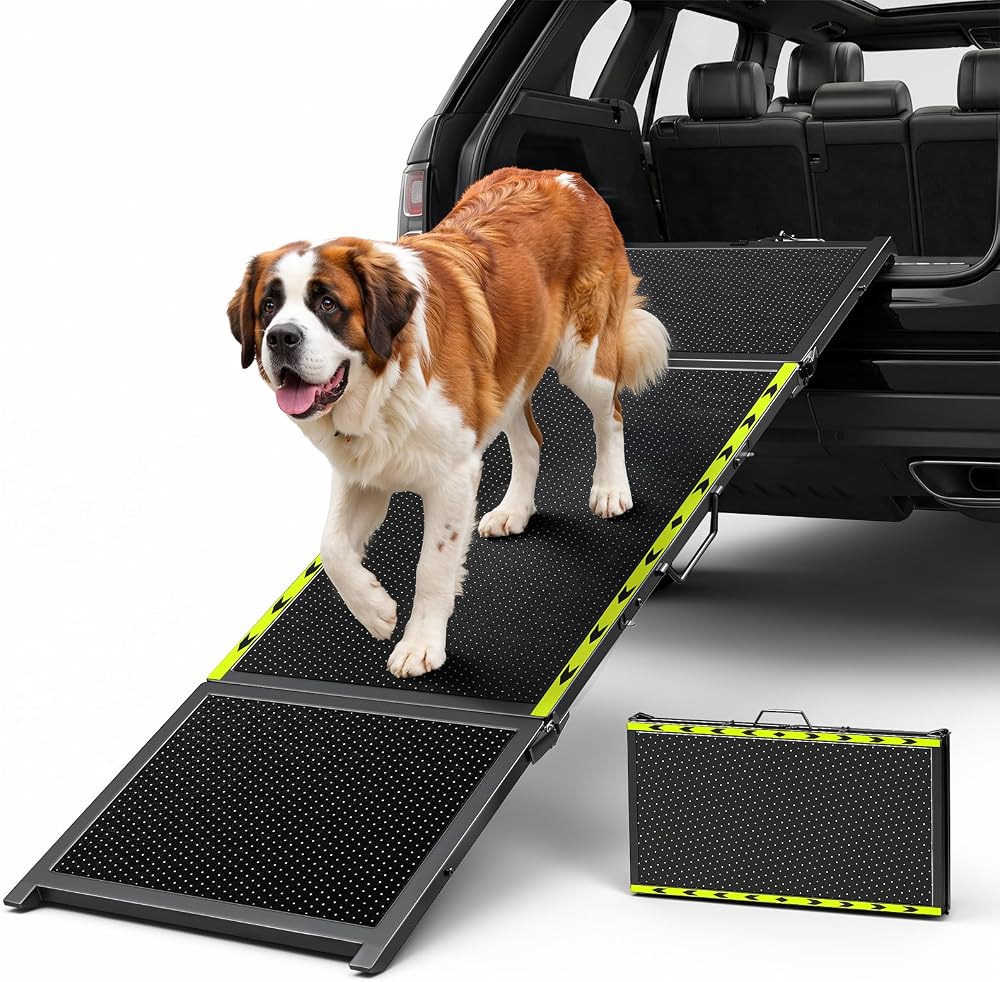
This extra-wide folding ramp is the most balanced default for most SUV owners. At about 74 inches long and a full 20 inches wide it gives a large dog room to place all four paws, and the long deck keeps the climb gentle into a typical SUV cargo floor. A non-slip surface and a solid folded form make it practical for everyday use. The main compromise is bulk, so measure your boot before buying.
Check current price on Amazon →2. PetSafe Happy Ride Compact Telescoping Ramp · Best adjustable
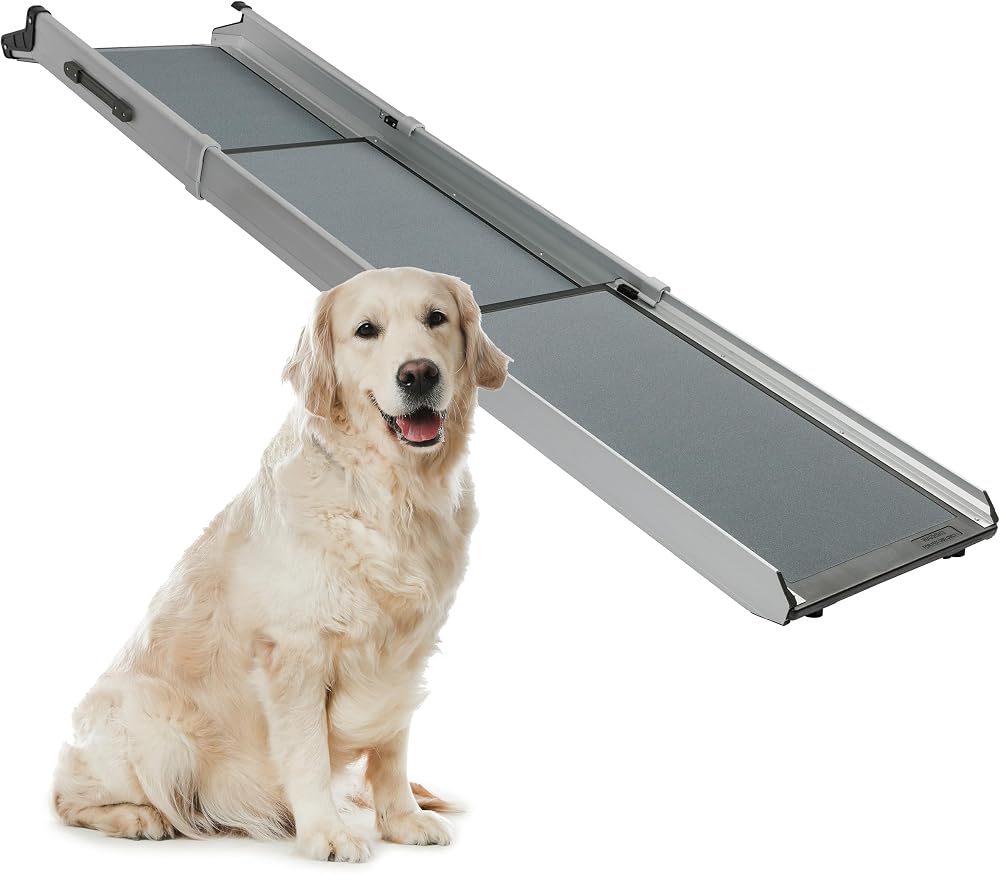
This telescoping ramp slides from about 28 to 70 inches, so one ramp can serve a low sedan today and a tall SUV tomorrow. A published 300 pound capacity plus rubber feet, side rails and a safety latch make it a sensible pick for large or giant breeds and multi vehicle homes. The surface can feel coarse to some dogs, and it is bulkier collapsed than a simple folding ramp. Introduce it flat and confirm the top section rests securely on your vehicle.
Check current price on Amazon →3. 87″ Aluminum Extra-Long Ramp · Best for tall trucks
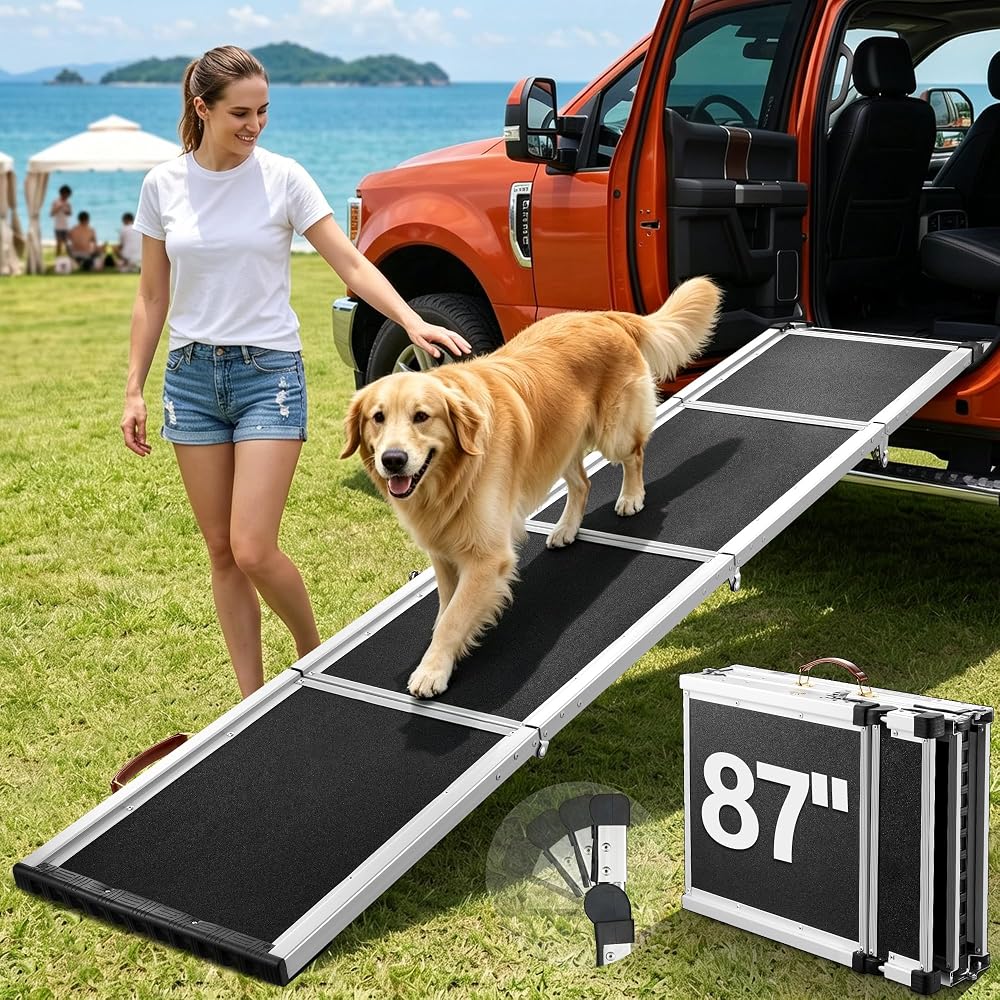
When the load floor is a pickup tailgate or a lifted SUV, only length keeps the angle safe, and at about 87 inches this aluminum ramp offers the longest reach in the guide. The aluminum frame stays rigid without being heavy for its size, and the long run turns a tall climb into a gentle one. It is the least compact option to store, so it suits owners who have the space and genuinely need the reach.
Check current price on Amazon →4. Pet Gear Tri-Fold 71″ Ramp with SupertraX · Best tri-fold
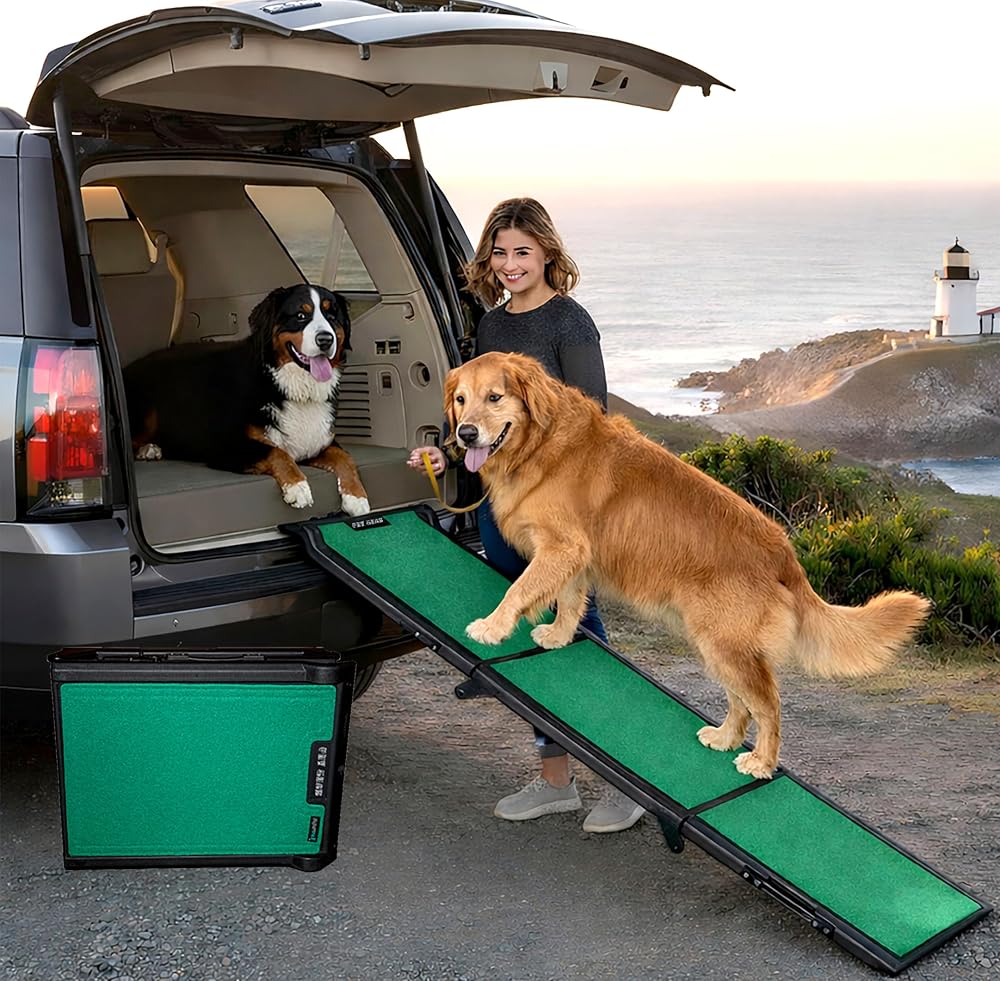
This tri fold shortens the stored length by folding into three panels instead of telescoping, and the SupertraX surface is designed to grip under paw pressure. The full 71 inch deck suits SUVs, while three panels fit across a cargo area more easily than one long ramp. It remains thick and broad folded, and the hinges are worth inspecting for play before each trip.
Check current price on Amazon →5. PetSafe Happy Ride Folding Ramp · Best lightweight
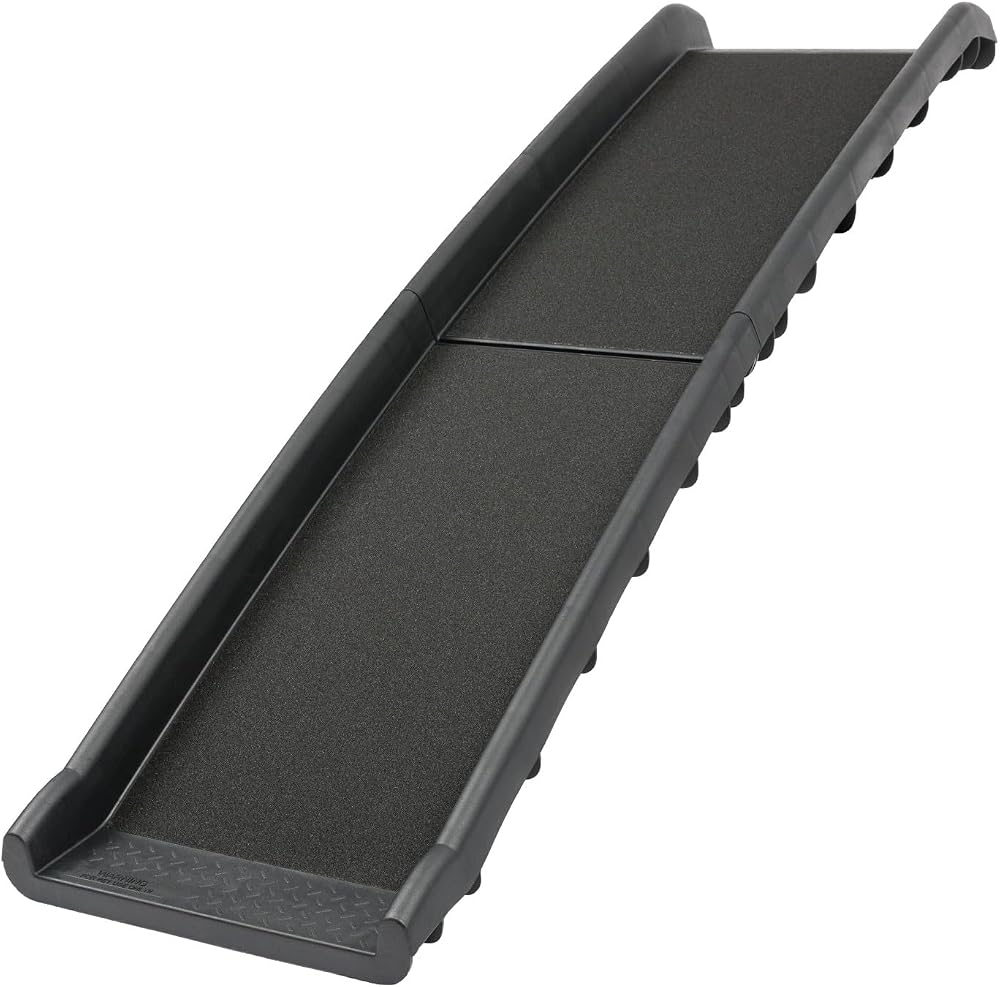
At about 10 pounds and a simple bi fold, this is the easiest ramp here to lift, carry and deploy, which matters if a heavier ramp would end up unused. Its roughly 62 inch length and 150 pound capacity make it a lower vehicle tool that is excellent for sedans, hatchbacks and lower crossovers but too short to stay gentle at a tall SUV or truck. Treat it as a low vehicle or lighter dog option rather than a universal car ramp.
Check current price on Amazon →6. Extra-Wide 74.8″ x 20″ Folding Ramp · Best extra-wide
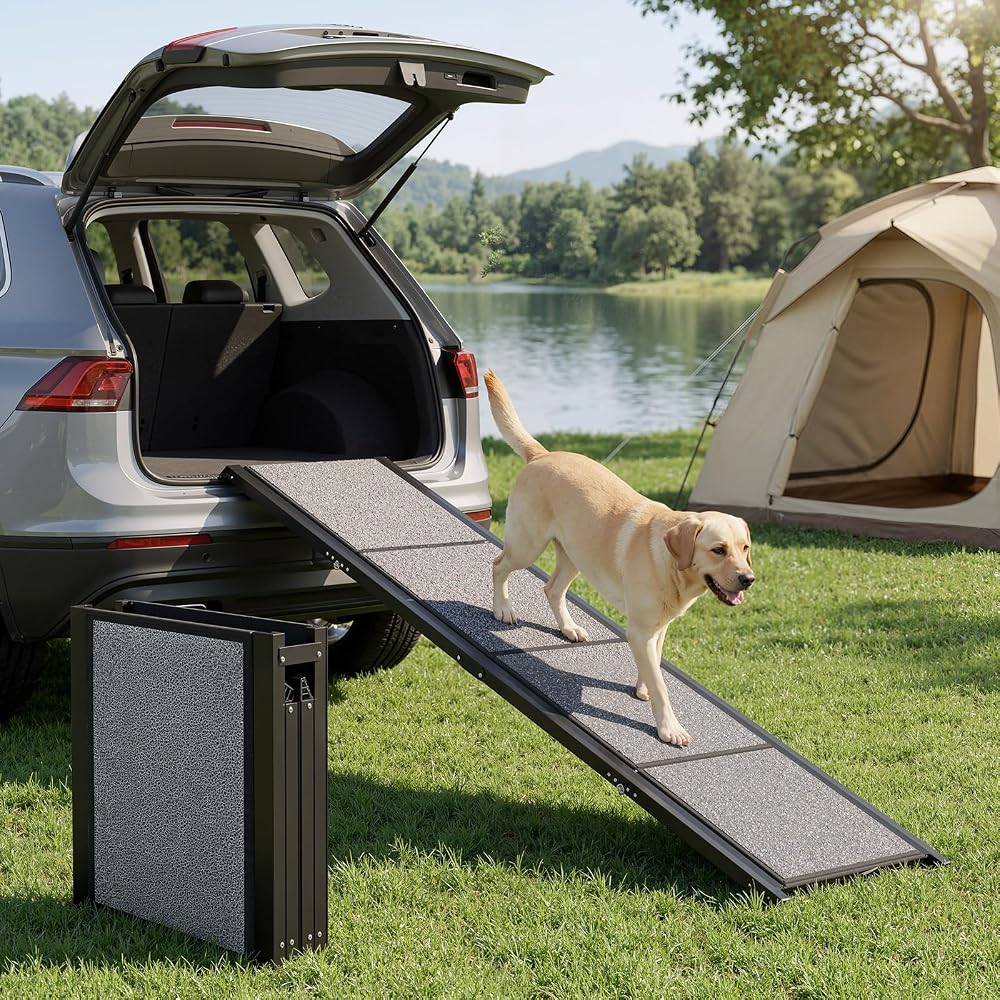
This ramp pairs a long 74.8 inch deck with a full 20 inch width and carries one of the strongest owner ratings in the category. The extra width gives a big or unsteady dog room to correct a misplaced paw, and the length keeps the incline forgiving at SUV height. Like any 20 inch wide ramp it needs real cargo room, so check that it fits alongside your usual luggage.
Check current price on Amazon →7. PawStep Portable Folding Ramp · Best budget
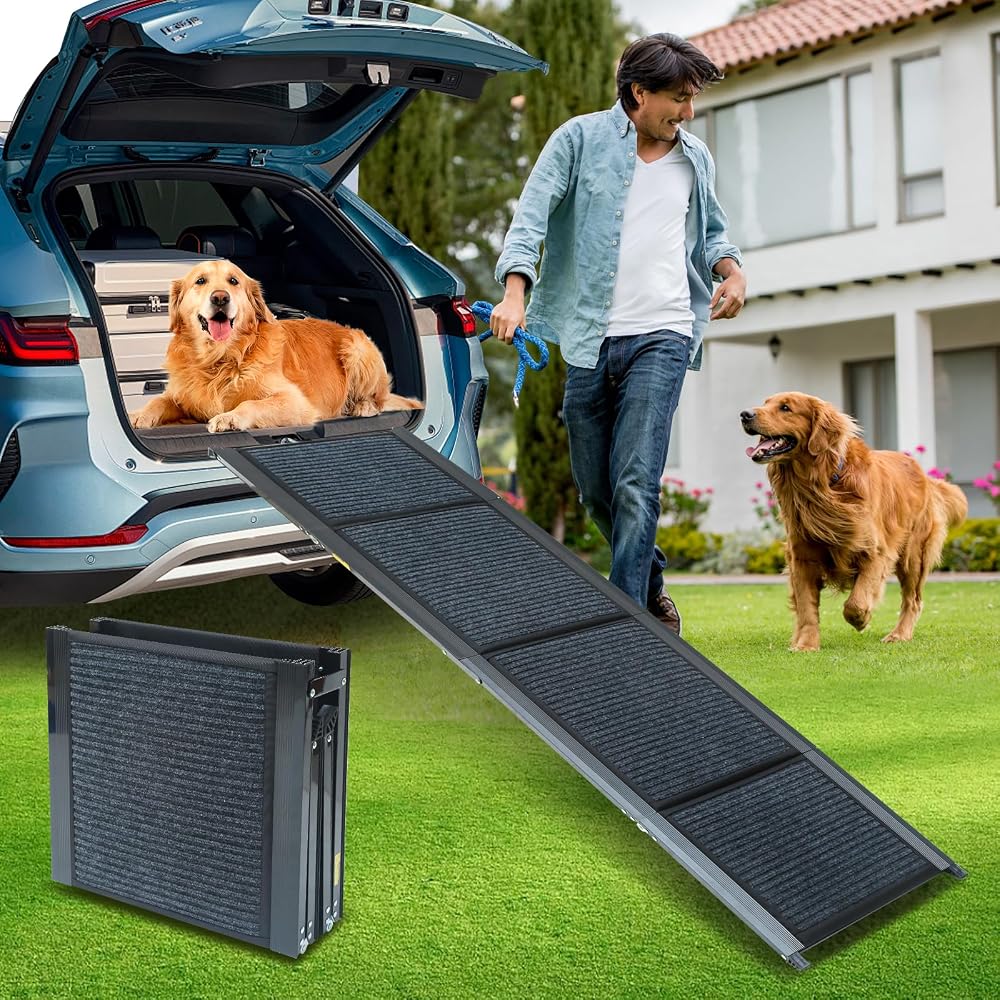
The PawStep folding ramp covers the essentials, a non slip surface and a fold flat design, at a lower price than the premium names. It is a reasonable entry point for lower vehicles and confident dogs when the alternative is lifting a dog that resists being carried. Budget ramps usually compromise on length and width, so judge it against your actual vehicle height rather than the appealing price.
Check current price on Amazon →8. High-Grip 71″ x 20″ Non-Slip Ramp · Best non-slip surface
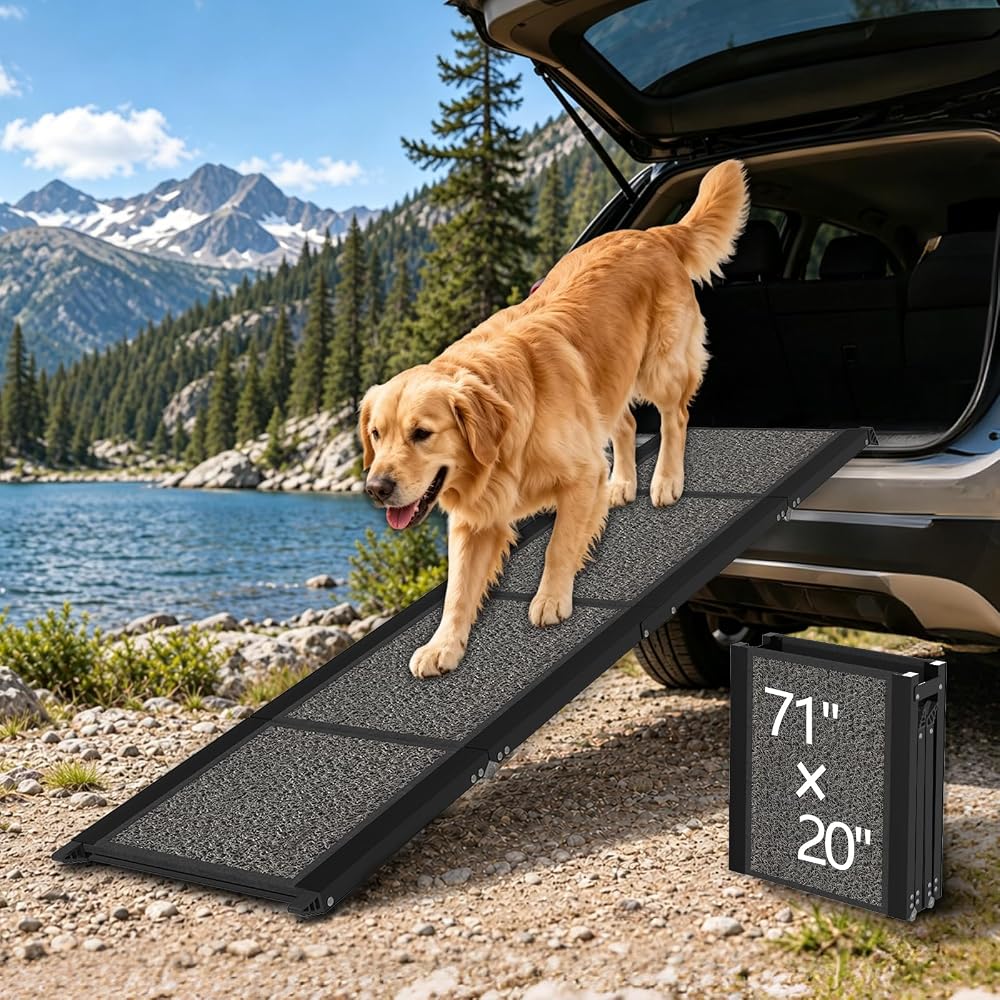
For owners who deal with wet paws and muddy trips, this 71 by 20 inch ramp leads with an aggressively textured, easy clean walking surface and a wide deck. Traction is the standout, and the width helps a dog stay centered on a slick day. It is a newer listing with fewer reviews than the established brands, so confirm the current specifications and inspect it on arrival before trusting it at height.
Check current price on Amazon →9. Compact 63″ x 17″ Folding Ramp · Best for low cars
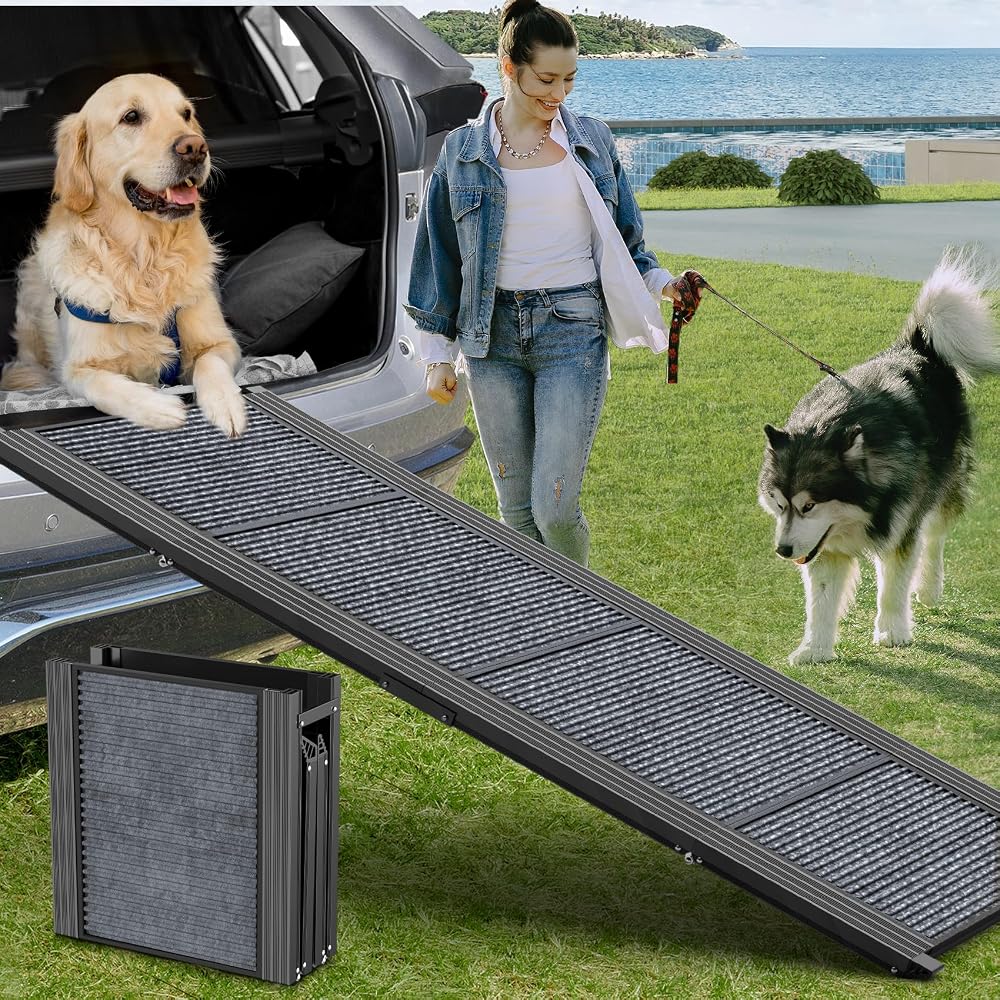
At about 63 inches this shorter folding ramp is easier to handle and store than a full 71 to 74 inch model, and it works well for a low hatchback, wagon or lower crossover where the angle stays reasonable. Do not choose it purely because it fits the boot: its shorter length can become steep at a tall SUV, and a compact deck leaves a big dog less room to recover a paw. Measure first and watch the descent.
Check current price on Amazon →10. Dog Stairs with Guardrail · Best step alternative
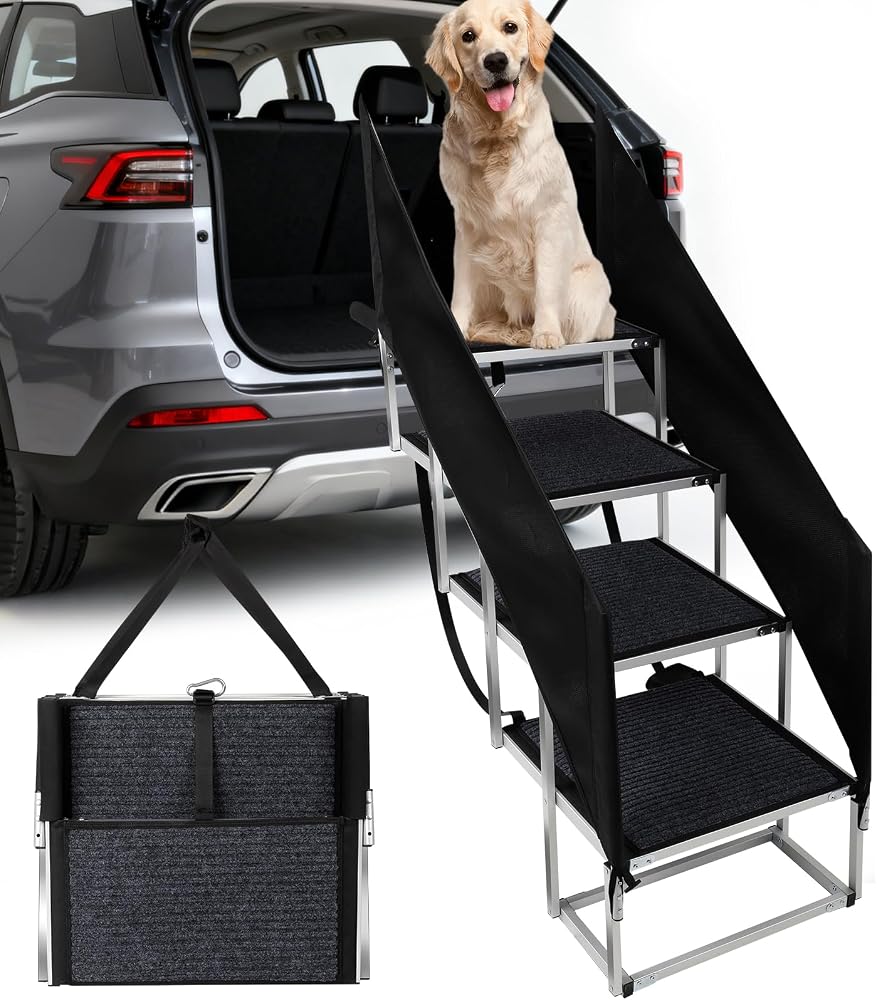
Some dogs simply refuse a long, narrow ramp. For them, a set of broad, guard railed steps can feel more secure because each footfall is a defined platform rather than a continuous incline. Side guardrails add confidence, and the format suits lower vehicles and dogs that dislike ramps. Steps are not ideal for a dog with significant arthritis, where a shallow continuous ramp is usually kinder, so match the format to the dog.
Check current price on Amazon →Which ramp fits your dog and vehicle
| Situation | Recommended starting point | Reason |
|---|---|---|
| Senior or arthritic dog in a tall SUV | Adjustable telescoping ramp | The adjustable length can reduce steepness |
| Large dog that drifts sideways | Wide 20 inch full length ramp | More width gives room for controlled paw placement |
| Owner with lifting restrictions | Light bi fold ramp for a low vehicle | Lower weight improves consistent use |
| Very tall truck bed or lifted SUV | Longest compatible ramp, up to 87 inches | A short ramp creates an excessive angle |
| Dog that refuses a narrow ramp | Broad guard railed steps | Defined platforms can feel more secure |
| Small sedan or hatchback | Compact 63 inch folding ramp | A long wide ramp may not fit the opening |
How to measure a dog ramp for your car
- Park on level ground and measure the vertical height from the ground to the point where the ramp will rest.
- Measure the door or cargo opening and note trim, bumper lips, latches or gaps that could interfere with the upper edge.
- Measure the cargo area as it will be packed for travel, then compare with the ramp folded length, width and thickness.
- Confirm your dog current weight and choose a rated capacity with a sensible margin.
- Check whether the ramp needs a tether or latch point and whether your vehicle provides one.
- If possible, mock up the working length with a tape measure and make sure there is clear ground to deploy it safely.
How to train your dog to use a car ramp
A good ramp can still fail if the first experience is frightening. Train away from traffic and do not begin at full vehicle height.
- Place the ramp flat on a non slip surface and reward your dog for looking at it, approaching it and placing one paw on it.
- Guide the dog across the flat ramp with treats or a target, keeping sessions short and calm. Do not drag the leash or push from behind.
- Raise one end only slightly and practice both directions. Going down often needs more confidence and braking control.
- Increase the height gradually while preventing jumps from the side. Add a helper beside the ramp if your dog is uncertain.
- At the vehicle, secure the ramp exactly as directed, turn off the engine and remove distractions, then reward a slow complete crossing.
- If the dog freezes, scrambles or jumps off, lower the difficulty. Improve traction or reduce the incline before trying again.
Safety mistakes to avoid
- Using a short ramp on a high SUV because the weight rating looks sufficient
- Letting the upper edge rest on unstable trim, a loose bumper protector or an open gap
- Assuming a textured surface means the whole ramp cannot slide
- Allowing a dog to jump from the side or top before finishing the descent
- Using a damaged hinge, cracked deck, missing foot or loose tread covering
- Training for the first time in a busy parking area
- Forcing a painful, frightened or neurologically impaired dog to continue
A sudden refusal to jump, climb or enter a vehicle can signal pain or weakness. Contact your veterinarian if your dog limps, cries, trembles, drags the toes, crosses the hind feet, falls, cannot rise normally or shows a sudden change in bladder control. Equipment can improve access, but it cannot diagnose or treat the cause.
Frequently asked questions
What is the best dog ramp for an SUV
For many SUVs, start with a stable ramp around 72 to 74 inches long and a wide deck, then adjust for the measured cargo height. Our overall pick is a balanced option, while a tall SUV or mobility limited dog may need the adjustable length of a telescoping ramp.
How long should a dog ramp be for an SUV
There is no single length for every SUV. Measure the loading height and use the longest practical ramp that fits the attachment point and storage area. Crossovers may work with roughly 66 to 72 inches, while taller SUVs and trucks often benefit from 74 to 87 inches or a telescoping model.
Are dog ramps safe for senior dogs
They can be when the ramp is stable, wide enough, non slip and shallow enough for the dog to move slowly in both directions. A steep or shifting ramp can be unsafe. Ask your veterinarian for guidance if your dog has arthritis, weakness, a neurologic condition or recent surgery.
Is a folding or telescoping ramp better
Folding ramps usually deploy quickly and store in a shorter block. Telescoping ramps offer adjustable length, useful for different vehicles and tall loading points. Choose based on the required incline, stored footprint, weight and how confidently you can secure it.
What width should a dog car ramp be
The dog should be able to walk without placing paws near an edge. Large, wide bodied or unsteady dogs need more width, so a 20 inch deck helps. Compare the tread width, not only the exterior measurement, and watch whether your dog moves straight or drifts.
Can a dog ramp damage a car
An incompatible upper lip, grit under the contact point or poor placement can mark trim or press on a weak surface. Follow the maker instructions, clean contact areas and use only approved protectors that do not make the connection unstable.
The PetBuyLab verdict
Choose the ramp that creates the safest complete system of dog, ramp, vehicle and owner. The Extra-Wide 74″ x 20″ Dog Car Ramp is our best overall pick for typical SUV use. The PetSafe Happy Ride Compact Telescoping Ramp is the stronger fit for tall vehicles and dogs that need a gentler, adjustable approach, while the lightweight PetSafe Happy Ride Folding Ramp makes more sense for lower vehicles and owners who cannot lift a heavier ramp. Before you buy, measure the loading height, door width and storage area. A correctly sized mid priced ramp beats a premium product that is too short, too narrow or too heavy to use.

Olivia Isabella is PetBuyLab’s dog specialist and a lifelong dog owner with hands-on experience caring for senior and large-breed dogs. She researches, compares and lives with the mobility, comfort and everyday-care products she writes about, so she knows the practical details a spec sheet misses: how a ramp’s length sets the real slope a stiff-hipped dog will attempt, why surface grip decides whether a nervous dog commits, and how the wrong pick ends up unused in the garage. Every recommendation is built from manufacturer specifications, documented owner feedback and reputable veterinary sources, and is organised around a specific dog’s needs, never around commission. Her guides are informational and never a substitute for professional veterinary advice.